How to Use Your Health Plan
Main_Content
How to Read Your Summary of Benefits and Coverage
Information on your insurance card about your plan and your cost-sharing can help you figure out what your out-of-pocket costs will be. You also can find more information to help you on the Summary of Benefits & Coverage or SBC. For example, you’ll find information about deductibles on the SBC. The SBC also tells you the types of services your health plan covers and what co-pays or coinsurance you’ll pay.
A Summary of Benefits & Coverage is usually available when you shop for a health plan on your own or through work, or when you renew or change your plan. If you can’t find an SBC for your plan, ask the insurer, your insurance producer, or your employer for one. Just remember, short-term health plans aren’t required to give you an SBC. (A short-term plan is one that only covers you for 3 months or less and doesn’t have to follow the rules in the Affordable Care Act.)
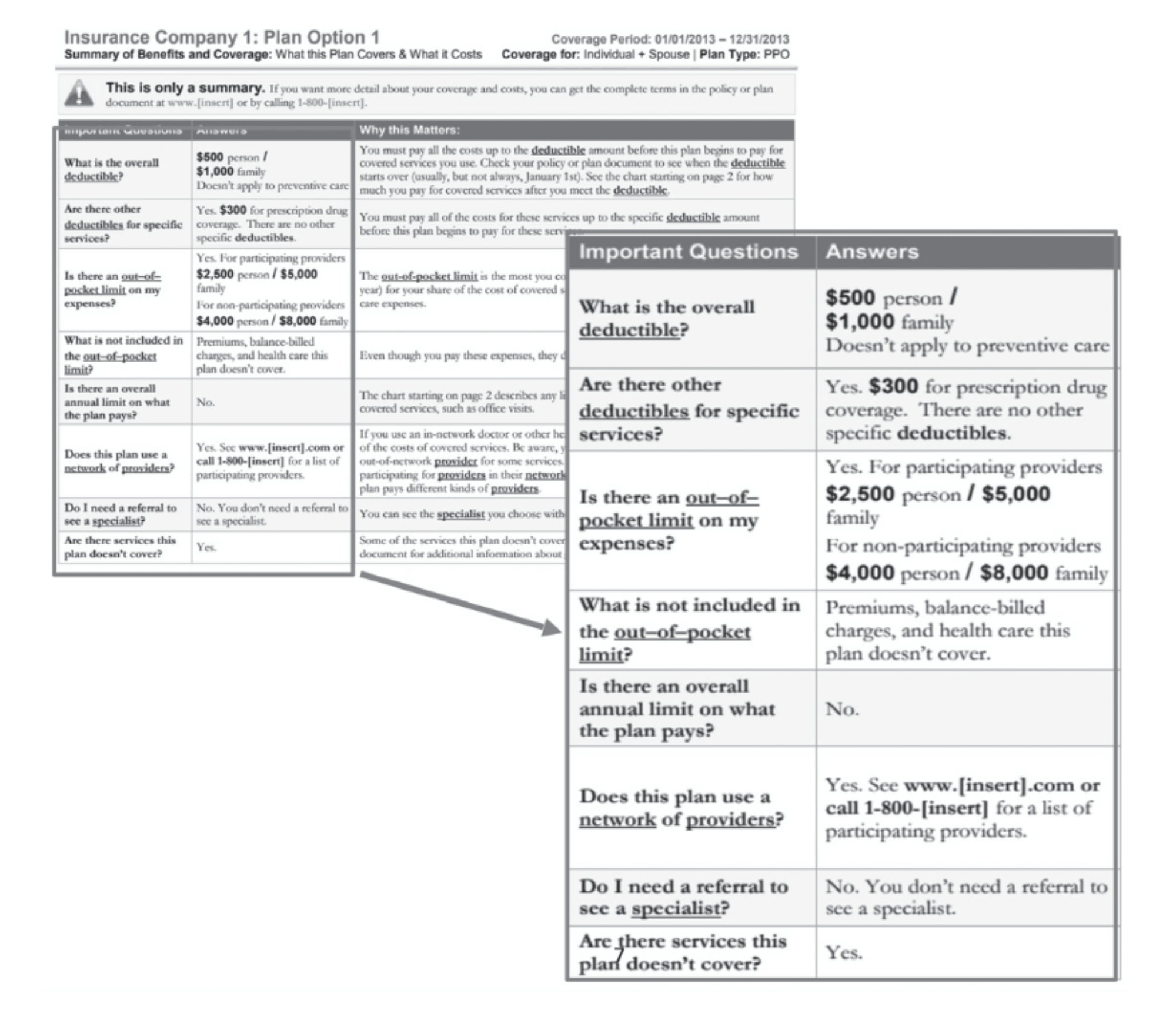
Below is a picture of the first page of an SBC to give you an idea of what an SBC looks like and the kind of information it gives. If you have questions about what the underlined words mean, remember to
check the Glossary.
You can get a list of the services your health plan covers, along with which costs you’ll have to pay. You’ll find this list in the Schedule of Benefits (if your plan is through work) or in the Outline of Coverage (if you bought your plan outside of work). Both list the various services a health plan covers, along with what costs you’ll have to pay. This document also shows which services the plan covers and doesn’t cover.
Many health insurers send a printed copy of your Schedule of Benefits (Schedule) or Outline of Coverage (Outline) when you first enroll in a plan. It’s usually with your insurance policy or certificate. You also may have access to an electronic copy in your member portal on the plan’s website. This list will help you get an idea of how much you’ll pay for services.
Keep this document with your insurance papers. “Benefits” is the term health plans use for health care services the plan covers. The Schedule (or Outline) lists the various categories of benefits your plan covers, such as preventive, hospital, medical, surgical, diagnostic, therapeutic, urgent care, and prescription drug services. For example, under preventive services, the schedule may list “Adult physical examination (1 exam per calendar year).”
A schedule or outline is usually broken into several sections:
The heading gives the basic information about your health plan. It explains what type of health plan you have (HMO, POS, EPO, PPO, or FFS/Indemnity), who the plan is through, the benefit year, and your plan’s start date. If you get your health plan through work, this start date will be for the company, not just you.
The
responsibilities section tells you the deductible, co-payments, and coinsurance and what the annual out-of-pocket maximums are.
The health benefits section lists the specific covered benefits. This section also often has information about your cost-sharing.
The
pharmacy benefits section identifies the prescription drug benefits in your health plan and the co-payment.
The
network(s) section tells you the provider network(s) your health plan has contracts with. When you use providers in the network (sometimes called preferred providers), your costs will be lower than if you use providers outside the network.
The
dependent benefits section lists which dependents your plan covers and for how long.
Get free help with your health coverage!
The Maryland Insurance Administration has a Health Coverage Assistance Team (H-CAT) to assist consumers. If you have questions or concerns about health coverage for you or your loved ones, the H-CAT staff is here for you.
- Get answers to your health insurance questions.
- Address health insurance problems or concerns.
- File a complaint about your health insurance issue or concern.
- Connect you to resources.

Phone: 410-468-2442
